Showing posts with label sacred geometry. Show all posts

Wednesday, 20 November 2013

MANDALA - Digital Designs


 After drawing out some of my mandalas by hand, I wanted to develop them further using my digital design skills to redraw and colour the design. The beauty of the mandala is that there is no rules, just your mind and the medium, they can be created in what ever way that you want. 


 The mandala is supposed to be a reflection of your sub conscious, but what ever way you want to look at it, spiritually or artistically, it is still a really therapeutic technique which stimulates the mind and brain and helps to get the creative juices flowing.


The creation of the mandala is like a journey which starts at the center and expands outwards growing and changing as you see fit. I will include the mandalas I have created throughout the book as examples and colouring in tasks etc, it was important to draw my own mandalas to see how it affected my practice.


One of the things about the mandala is that it can be extremely complicated, the more you progress with it, there are countless overlaps within the geometry you can use and sometimes it take you a while to figure out what the best option is, Here you can see how this mandala changed and progressed as I went along. I tended to just stick to my gut instinct and let the rest happen.


Of course mandalas don't have to be digital in fact is is a very hand crafted style of working traditionally but I wanted to apply my knowledge of digital appliances to create my mandalas, I think this says something about my practice. My combining digital methods with traditional art I am exploring the boundaries of mandala making and also staying to true to my interests and passions.

  
I found that when I created mandalas at first my mind came up with quite simplistic forms, but as I carried on and progressed with my designs, they became more complicated and interesting and it started to become easier to visualize what I wanted to create. 


One aspect of the book looks at the use of mandalas in religion, here you can see a christian mandala in the form of the stained glass window at church. To represent this in the book I will create a laser cut out wall silhouette like on the left, the following pages with be printed on acetate to represent the glass, I am considering layering up a few pages to get the mix of colours in the window. It might be more appropriate to just have the 1 sheet, However this might not work in the book signatures.


The fruit of life pattern will be in the book as a guidline for people the user to work with, This allows them to use this as a tracing element which will make it easier for the user to pick out shapes etc.


I still have allot to do with this brief and really need to get underway. I have planned out the content for the book but still haven't experimented with alternate designs. I also have to write the copy for the book and also photograph some of the tasks at various stages. I also need to consider what stock I will use and also design the box and source the equipment needed for the kit. I have quite allot of work on my plate, but I shouldn't have too much of a problem completing the brief. I need to book the laser cutter and some print slots too.

Tuesday, 19 November 2013

MANDALA BOOK PLAN


 Today I started planning out the content for my publication. I am trying to make it as visually engaging as possible in order to draw the user in, I think it is important to emphasize the beauty of the mandala and how simple and easy it is to create your own. The publication looks at the traditions and history behind the mandala, and displays them in engaging and interesting formats. I am trying to create interactive elements to the publication which will spark interest and hopefully force the user into engaging with the product. There is something for everyone within the publication. If the user doesn't feel comfortable drawing their are other fun options to engage with. I am trying to keep the copy relatively short and to the point, there will be plenty of information, but not too much text to put the reader of carrying on.


The last section of the book is the help guide to creating your own mandalas. The first section gives examples of the various mandalas that the user can create. I will sew and colour in some mandalas etc, then photograph the examples to show how they can be done. It will show a step by step guide of how to start making some simple mandalas to get the user going. This section talks the user through each of the techniques, sewing, colouring and drawing and explains them in a simple way. I want to emphasize how the process is beneficial for creativity and also as a relaxing art form which helps to take your mind off things and solely concentrate on creation.
 

I created a mock up of the book to work out a good size for the publication. The kit needs to be small enough to carry around but big enough to fit in the tools and accessories aswell as the book. This format is big enough to display the information well with room spare to play with the layout. I am working with a square artboard as usually most mandalas consist within a square so this an appropriate format to work with which will work well with my imagery. I need to research into stock for the publication as I will be using different media.

Sizes

Page Size : 200mmx185mm
Art board : 175mmx175mm
Margain : Inside 2mm Outside, Top, Bottom 5mm

Monday, 18 November 2013

Manadala Book Research

I  
The Mandala Book - Patterns of the Universe
Lori Bailey

I did a bit of research into existing mandala books. I came across various books, which looked at mandalas and found there was no consistent design style, most of the publications have a very hand crafted aesthetic, which represents the nature of art form. However this approach doesn't really grab your attention. The publication above is quite eye catching and I feel appeals to a wider target market as apposed to the versions you can see below. The designer has used natural examples which highlight the colour spectrum usually used when creating your own mandalas which i think helps to draw the consumer in. 

 
The Mandala Workbook - A creative Guide to 
Self Exploration, Balance and Well-being 
Susanne Fincher

The book above is really poor design, It emphasizes the hands on approach to creating the mandalas but I don't really think it grabs the viewers attention and reminds me of a terrible dated text book you would get in R.E The type really does nothing for design either, nothing really stands out that well. I think this book may appeal to a few people. But I am aiming to target this at a wider audience of people who maybe don't already have an interest in this kind of thing. So in order to grab the audiences attention I will have to produce something much more eye catching which will make the user want to engage with it.

 
Creating Mandalas - Susanne Fincher

Here is another book by the same author, Once again quite plain and text book like, I have found that most publications on this topic tend to have really poor designs which arn't that appealing to a wider audience.

Mandala: Spiritual Visions of our Ancient Self
Peter Patrick Barreda 

This publication has a much nicer design and doesn't look as tacky as the other designs. Its quite natural and earthy which relates to the natural process of creating mandalas. Its quite authentic and traditional which I also like. This style of design suits the product much better.

Mandala Colouring Book
Thaneeya McArdie

This book seems to be aimed at a much younger audience, the fact that it is a colouring book probably suggests this too. Once again I feel that this approach isn't the best option. And I am wanting to produce something more traditional which appeals to a wider audience. My aim is to try encourage people with no interest to give it ago. In order to do this I will have to produce some interesting packaging which makes the user want to get involved.
 
Mandala
Judith Cornell

Here you can see another example, As much as I like the image, I think it makes the publication look like some random text book for software. Pretty much the majority of books I found on mandalas looked prettty terrible. I am confident I can think of some interesting ways to make the publication appeal to a larger bracket of people.

Wednesday, 13 November 2013

MANDALA : PRIMARY RESEARCH & DIRECTION


In order to find out what personal benefits I could get from drawing mandalas I spent the afternoon with a pencil, compass and ruler drawing mandalas and looking at some of the patterns I learnt about from researching into sacred geometry and the art of making mandalas. I found the whole experience extremely therapeutic, and found that my mind was solely focused on playing with geometry and working out what I wanted to do next and where the image was going, I found my self emerged in my work which was a really nice experience. Every one I produced took a complete different direction which was really interesting. There are infinite outcomes to explore which can include countless geometric shapes and patterns. For this exercise I just worked with geometric mandals. But of course mandalas don't have to be so precise and clean cut they can be rough and created in any medium as long as it revolves round a central point. The beauty about the mandala is that anyone can create them. There not just created for religious reasons and anyone can find fun and peace in creating them.


This mandala is based on the fruit of life pattern from my sacred geometry research, there are loads of geometric forms that can be found within this pattern which is really interesting. You can find all of the platonic solids, within this pattern. I illustrated the Hexagon here, I like how the image has a 3D quality, the cube form pops out from the page. By rotating a triangle around the central point it created the star form.


Here I experimented with concentric circles to produce this mandala I also rotated shapes around this to create the star like formation.


After producing a few I got into the swing of things and the patterns started to become more complex. You start to see other possibilities and the mandala takes a different form. I found it interesting that the mandalas 
took vary different forms every time and I kept finding different forms to work with. The experience 
was really quite enjoyable.


Here you can see the fruit of life pattern


DIRECTION
 

Concept:

The books purpose is to inform people about mandalas and how they can create their own. The publication will explore the traditions and cultures behind this beautiful art form. The book will have various options for the user to create mandals and will also highlight the benefits of producing your own.

Audience: 

The target market is mainly people with a spiritual interest as they are likely to have knowldgege of these, however they have a recongnisable visual quality which many people may recognise or been drawn to. It also relates to people with an interest in art and patterns. Mandalas do have spiritual connotations but the art of producing them is fun for everyone.

Content

Introduction:

The meaning behind the mandala
Natural Mandalas
Spiritual Beliefs 

Culture

Hinduism
Buddhism
Christianity

How to create your own

Examples of versions
Step by step guide
Blank Pages for experiemtns
Colouring in
Sewing
Stickers? 

DIY Mandala Ideas


I brainstormed a few ways I can make the publication more interesting by using different stock and including added extras to the publication which has lead me to push the publication further.

Acetate : I think it would be interesting to show how mandalas can be built up so printing on acetate is a good idea as it would show the progression of the mandala and also give a cool effect a bit like a stain glass window mandala which can be found in churchs. This will illustrate the aspect of christian mandalas.

Spinning element : Most mandalas have a revolving theme to the image as all the shapes rotate around a central point, I want to illustrate the movement within the mandalas by adding a spinning element which illustrates and animates the movement.


Sewing Grids : Mandalas can be created in what ever form you want. With that in mind I thought it would be interesting to sew mandalas. Sewing takes allot of concentration and is very structured and ordered, these qualities match that of drawing mandalas so the combination will be a very therapeutic but focused project. I plan to laser cut out various grids and patterns for the user to sew.

Stickers : It might be cool to print various stickers out as another option for the user. However this might not work that well I will have to experiment.


Box : I plan to build a box for the publication and added accessories. The pack will include tools to for the user to create their own mandalas. The package will be the perfect kit, which could be transported about with ease so the user can find a nice relaxing spot and chill out with their brand new mandala kit.

Monday, 4 November 2013

Mandala Brief : What I need to do

Research:

Target audience 

  • what books are already out there?
  • how can I make my publication stand out?
  • how can I appeal to a wide range of people?
  • I want to try attract a wide audience which doesn't exactly focus on spiritual people but those who like craft and design. The mandala doesn't have to be spiritual. it has beautiful aesthetic qualities and the process of making them is very therapeutic. This is an important aspect of it.
Visual Research
  • Exsisting Mandalas
  • Different Cultures
  • Different Meanings
  • Crafting kits
 Publication Research
  • Existing Mandala books
  • DIY Kits
  • Format
Practical Response:
  • Design the Content of the Book
  • Laser Cut Pages
  • Design Colouring pages
  • Make Book
  • Make Box
What Have I done so Far

So far I have researched into the cultural aspect of mandalas and how to create them. My project is much more focussed now. Rather than looking at the broad topic of sacred geometry I have decided to put all my focus on mandalas. Althought they have spiritual and religeous connotations. I believe that the art of producing one can be fun and theraputic for all. It takes a good bit of concentration to produce one and lots of hard work and precision. There are many ways you can create the mandala but the main focus is that it all revolves around a central point. The circle represents unity and oneness, there is something really mesmerizing about the circle that can draw you in. Your mandala is supposed to say something about the way you are feeling and the things that are going on in your life.

I have spent a good day drawing my own mandalas using a compass and ruler. I found that this was rather dificult to start with and my mandalas started out fairly simple, but once I got the hang of things the mandalas progressed and became more complex introducing more shapes and styles. I found that the process was really enjoyable and got my brain working in geometric terms. I found the more I produced the easier it was for me to work out what I was gonna draw next and how the mandala could progress. 

I have planned the basic content of my book but I will need to finalize everything I will include and work out how I will produce the publication and exactly what will go in it. I have quite a few different ideas of how the user can produce mandalas in various ways. I think having a variety of options will make the publication more appealing.

Wednesday, 9 October 2013

Sacred Geometry Explained


I came across these short clips giving a brief overview of sacred geometry. The topic is so huge and mysterious that it will be hard to convey all the information that there is. The theories are quite controversial aswell and do not follow everyone's beliefs. Sacred geometry is the building blocks of the universe, the same pattern can be used to describe all aspects of the world. To understand the concept of sacred geometry we have to accept that the universe is consciousness and that everything in the universe is connected. Even if most people find these theories a bit far out. I believe that the principles and ethical side of sacred geometry is something worth living by.

If we accept that everyone and everything is connected we can change our lives in a way that betters ourselves and the lives of others. You have to comprehend that we live in a holographic universe, everything can be reduced to 2 things, structure and consciousness, but even structure exists from consciousness. Even though the world as we know it seems very solid and real. 

If everything in the universe is made up of matter then how can consciousness be created from matter?
This is not possible so matter must come from consciousness.


Sacred geometry can be described as a belief system attributing a religious or cultural value to many of the fundamental forms of space and time. According to this belief system, the basic patterns of existence are perceived as sacred, since contemplating one is contemplating the origin of all things. By studying the nature of these forms and their relationship to each other, one may seek to gain insight into the scientific, philosophical, psychological, aesthetic and mystical laws of the universe.[

Metatron is the holder of the keys to the Universe and all that resides within it. 

Everything that exists does so because of sacred geometry. Nothing would exist without it.

The Five Platonic Solids:

The Five Platonic solids are crucial as they form the building blocks for all organic life. They are found in all organic life forms, minerals, music, language and sound.  Fire, Earth, Air, Aether (the material that fills the region of the Universe above the terrestrial sphere), Water. 


Symbolized as follows:

Star Tetrahedron - Fire
Hexahedron - Earth
Octahedron - Air
Dodecahedron - Aether
Icosahedron - Water

These are all contained within Metatron's Cube. 


The Seed of Life
The "Seed of Life" is formed from seven circles being placed with sixfold symmetry, forming a pattern of circles and lenses, which act as a basic component of the Flower of Life's design.

The Seed of Life is a symbol supposed by the New Age community to depict the six days of creation in which the Judeo-Christian God created life; Genesis 2:2-3, Exodus 23:12, 31:16-17, Isaiah 56:6-8. The first day is believed to be the creation of the Vesica Piscis, then the creation of the Tripod of Life on the second day, followed by one sphere added for each subsequent day until all seven spheres construct the Seed of Life on the sixth day of Creation. The seventh day is the day of rest, known as the "Sabbath" or "Shabbat."


Fruit of Life:


The Fruit of Life is a shape taken directly from the Flower of Life (see above).  It is made of thirteen equal sized circles.  If you connect the centre of each circle to the others with a straight line, you end up with 78 lines in total. The final shape forms what we refer to as Metatron’s Cube.  Within this shape or cube, many other shapes can be found, including two dimensional versions of the five Platonic Solids.  Metatron's Cube is, therefore, the template that delineates the Platonic solids. 

The Egg of Life

The "Egg of Life" symbol is composed of seven circles taken from the design of the Flower of Life. The shape of the Egg of Life is said to be the shape of a multi-cellular embryo in its first hours of creation.


Derived from the Egg of Life is the basis for the following geometrical figures:
  • Cube – One of the platonic solids
  • Tetrahedron – One of the platonic solids
  • Star tetrahedron – Much like the Jewish Star of David.
Egg-of-Life Stages.svg

Tree of Life

The symbol of the Tree of life may be derived from the Flower of Life. The Tree of life is a concept, a metaphor for common descent, and a motif in various world theologies and philosophies.The Kabbalistic form of the Tree of life has historically been adopted by some Jews, Christians, Hermeticists, and pagans.Along with the Seed of Life, in New Age Qabalah it is believed to be part of the geometry that parallels the cycle of the fruit tree. This relationship is implied when these two forms are superimposed onto each other.


The Tree of Life is most widely recognized as a concept within the Kabbalah, which is used to understand the nature of God and the manner in which he created the world ex nihilo. The Kabbalists developed this concept into a full model of reality, using the tree to depict a "map" of creation. The Tree of Life has been called the "cosmology" of the Kabbalah. Jewish Kabbalists related the Kabbalistic Tree of Life to the Tree of life mentioned in Genesis 2:9

Metatron's Cube:

Metatron's Cube contains all the 5 platonic solids encompassed in one magnificent shape.  It is present in many of the ancient mysteries including Egyptian mythology, ancient Judaic teachings and in alchemy. It is a primordial and very powerful image. (some excerpts courtesy of www.patinkas.co.uk).

Just by meditating on this cube image one can begin to see all the 5 platonic shapes interlinked, intertwined in graceful harmony. 


This is only a very brief glimpse of Sacred Geometry. Explore Sacred Geometry. It is fascinating. When we work with Metatron especially in a healing capacity, the healing codings that come down to us come in many forms. They bring magnificent healing frequency to balance, rejuvinate, readjust and realign the physical vessel (human form). This is why the healing is so profound as we are working with frequential codings that match our blueprint/fixed design and so bring us to a state of equilibrium within and often exceeding our expectations of who we are or who we believe we are within ourselves. Metatron unlocks the doorway for you to begin to see your true divine potential. 

Sacred Geometry - Reading

I have rented out to books from the library which have given me a bit of an insight into the world of sacred geometry. This geometry is rooted deeply into the fabric of nature and has been studied and used for thousands of years. Although we can find proportions repeated through the natural world it is something that seems to be covered up in today's society. There is something that we are not been told. These geometric patterns surely have some profound effect on the universe. It is argued that sacred geometry is the building blocks of everything in existence.

Book 1-  Sacred Geometry 
by Robert Lawlor

This book is an introduction into the geometry which, as modern science now confirms, underlies the structure of the universe. The thinkers of ancient Egypt, Greece and India recognized that numbers governed much of what they saw in the world and hence provided an approach to its divine creator. Robert sets out the system that determines the dimension and form of both man - made and natural structures, from gothic cathedrals to flowers, from music to the human body.

Book 2 - Geometry of Design
Kimberly Elam

In this book Kimberley uncovers the mysterious relationship between mathematics and beauty. She takes us into the magical realm of geometry - of golen sections and divine proportion and the Fibonacci Sequence. She shows how symetry, order and visual balance underlie various aspects of design work.

Overview
 
From reading through the books there are certain topics I would like to include within my publication in order to give the audience an overview of sacred geometry where it is found and how it is used. The theory behind sacred geometry is quite a heavy concept to grasp, but hopefully this publication will help people to understand the importance of geometry within nature and help people to realise we are all connected. There is one pattern for life and it shows how everything is built from the same structure. Unity is key.

This geometry is used in all aspects of design and helps to keep everything balanced and in proportion. It is something that should be explored and used in the creation of design and architecture. There is something about the geometry that people associate with spirituality. Sacred geometry has been used in religion since the ancient times. Mandalas are used to channel the artists energy as a form of meditation. These mandalas are present in almost every religious culture but they are created using different methods depending whereabouts in the world you are.

Topics to Cover

Universal Creation Patterns
Symbolism
Examples Natural Forms
Human Proportions
Tree of Life etc
Platonic Solids / Cosmic Volumes
Golden Ratio
Devine Proportions
Cymatics
Metatrons cube
Examples in Architecture
Examples in Design
Mandalas

Tuesday, 8 October 2013

Mandala Artwork


The word "mandala" is from the classical Indian language of Sanskrit. Loosely translated to mean "circle," a mandala is far more than a simple shape. It represents wholeness, and can be seen as a model for the organizational structure of life itself--a cosmic diagram that reminds us of our relation to the infinite, the world that extends both beyond and within our bodies and minds.

Describing both material and non-material realities, the mandala appears in all aspects of life: the celestial circles we call earth, sun, and moon, as well as conceptual circles of friends, family, and community. 

"The integrated view of the world represented by the mandala, while long embraced by some Eastern religions, has now begun to emerge in Western religious and secular cultures. Awareness of the mandala may have the potential of changing how we see ourselves, our planet, and perhaps even our own life purpose."
(From Mandala: Journey to the Center, by Bailey Cunningham)


cross-cultural patterns

The mandala pattern is used in many religious traditions. Hildegard von Bingen, a Christian nun in the 12th century, created many beautiful mandalas to express her visions and beliefs.

In the Americas, Indians have created medicine wheels and sand mandalas. The circular Aztec calendar was both a timekeeping device and a religious expression of ancient Aztecs.

In Asia, the Taoist "yin-yang" symbol represents opposition as well as interdependence. Tibetan mandalas are often highly intricate illustrations of religious significance that are used for meditation.

different cultures, similar expressions

Both Navajo Indians and Tibetan monks create sand mandalas to demonstrate the impermanence of life.

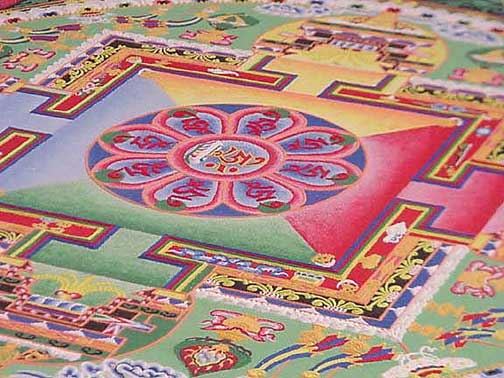
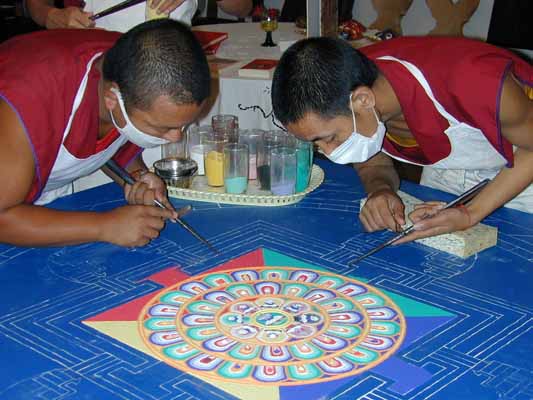
In ancient Tibet, as part of a spiritual practice, monks created intricate mandalas with colored sand made of crushed semiprecious stones. The tradition continues to this day as the monks travel to different cultures around the world to create sand mandalas and educate people about the culture of Tibet.

The creation of a sand mandala requires many hours and days to complete. Each mandala contains many symbols that must be perfectly reproduced each time the mandala is created. When finished, the monks gather in a colorful ceremony, chanting in deep tones as they sweep their mandala into a jar and empty it into a nearby body of water as a blessing. This action also symbolizes symbolizes the cycle of life.

A world away, the American Navajo people also create impermanent sand paintings which are used in spiritual rituals–in much the same way as as they are used by Tibetans. A Navajo sandpainting ritual may last from five to nine days and range in size from three to fifteen feet or more.

how mandalas heal
 
According to Buddhist scripture, sand mandalas transmit positive energies to the environment and to the people who view them. While constructing a mandala, Buddhist monks chant and meditate to invoke the divine energies of the deities residing within the mandala. The monks then ask for the deities' healing blessings. A mandala's healing power extends to the whole world even before it is swept up and dispersed into flowing water—a further expression of sharing the mandala's blessings with all.

mandalas in architecture

From Buddhist stupas to Muslim mosques and Christian cathedrals, the principle of a structure built around a center is a common theme in architecture. 

Native American teepees are conical shapes built around a pole that represents the "axis mundi" or world axis.
Buckminster Fuller expanded on the dome design with his famous geodesic dome structures. The dome structure has the highest ratio of enclosed area to external surface area, and all structural members contribute equally to the whole--a great structural representation of a mandala!

micro to macro

Representing the universe itself, a mandala is both the microcosm and the macrocosm, and we are all part of its intricate design. The mandala is more than an image seen with our eyes; it is an actual moment in time. It can be can be used as a vehicle to explore art, science, religion and life itself. The mandala contains an encyclopedia of the finite and a road map to infinity.


Carl Jung said that a mandala symbolizes "a safe refuge of inner reconciliation and wholeness." It is "a synthesis of distinctive elements in a unified scheme representing the basic nature of existence." Jung used the mandala for his own personal growth and wrote about his experiences.

It is said by Tibetan Buddhists that a mandala consists of five "excellencies":

The teacher • The message • The audience • The site • The time
 
An audience or "viewer" is necessary to create a mandala. Where there is no you, there is no mandala. (from: You Are the Eyes of the World, by Longchenpa, translated by Lipman and Peterson).


Thursday, 3 October 2013

Sacred Geometry Research

Introduction

Sacred geometry involves sacred universal patterns used in the design of everything in our reality, most often seen in sacred architecture and sacred art. The basic belief is that geometry and mathematical ratios, harmonics and proportion are also found in music, light, cosmology. This value system is seen as widespread even in prehistory, a cultural universal of the human condition. 

It is considered foundational to building sacred structures such as temples, mosques, megaliths, monuments and churches; sacred spaces such as altars, temenoi and tabernacles; meeting places such as sacred groves, village greens and holy wells and the creation of religious art, iconography and using "divine" proportions. Alternatively, sacred geometry based arts may be ephemeral, such as visualization, sand painting and medicine wheels.

Sacred geometry may be understood as a worldview of pattern recognition, a complex system of religious symbols and structures involving space, time and form. According to this view the basic patterns of existence are perceived as sacred. By connecting with these, a believer contemplates the Great Mysteries, and the Great Design. By studying the nature of these patterns, forms and relationships and their connections, insight may be gained into the mysteries - the laws and lore of the Universe. 

Natural Forms
 
Many forms observed in nature can be related to geometry (for sound reasons of resource optimization). For example, the chambered nautilus grows at a constant rate and so its shell forms a logarithmic spiral to accommodate that growth without changing shape. Also, honeybees construct hexagonal cells to hold their honey. These and other correspondences are seen by believers in sacred geometry to be further proof of the cosmic significance of geometric forms. But some scientists see such phenomena as the logical outcome of natural principles.


Sunflower


Cutaway of a Chambered Nautilus


Bee Honeycomb


Naturally formed basalt columns


Galaxies


North polar hexagonal cloud on Saturn


Vitruvian Man


Art and Architecture
 
The golden ratio, geometric ratios, and geometric figures were often employed in the design of Egyptian, ancient Indian, Greek and Roman architecture. Medieval European cathedrals also incorporated symbolic geometry. Indian and Himalayan spiritual communities often constructed temples and fortifications on design plans of mandala and yantra. For examples of sacred geometry in art and architecture refer: 

Golden Ratio 

Labyrinth


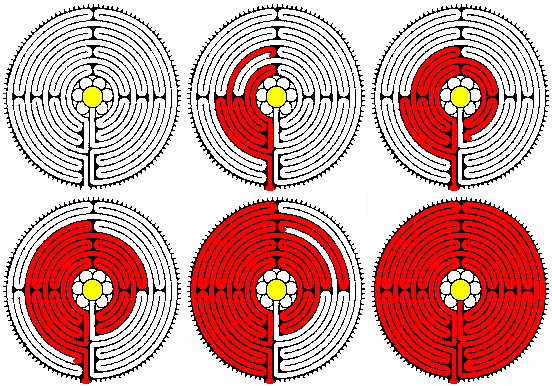
A labyrinth is an ancient symbol that relates to wholeness. It combines the imagery of the circle and the spiral into a meandering but purposeful path. It represents a journey to our own center and back again out into the world. Labyrinths have long been used as meditation and prayer tools. A labyrinth is an archetype with which we can have a direct experience. Walking the labyrinth can be considered an initiation in which one awakens the knowledge encoded within their DNA. 

A labyrinth contains non-verbal, implicate geometric and numerological prompts that create a multi-dimensional holographic field. These unseen patterns are referred to as sacred geometry. They allegedly reveal the presence of a cosmic order as they interface the world of material form and the subtler realms of higher consciousness.The contemporary resurgence of labyrinths in the west is stemming from our deeply rooted urge to honor again the Sacredness of All Life. A labyrinth can be experienced as the birthing womb of the Great Goddess. Thus, the labyrinth experience is a potent practice of Self-Integration as it encapsulates the spiraling journey in and out of incarnation. On the journey in, towards the center, one cleanses the dirt from the road. On the journey out, one is born anew to consciously dwell in a human body, made holy by having got a taste of the Infinite Center. 


 Mandalas

Mandala derives from the Hindu language meaning 'concentric energy circle.' A circle represents protection, good luck, or completion. Mandalas link with the spiraling movement of consciousness, sacred geometry, psychology, and healing. 

Psychoanalyst Carl Jung saw the mandala as "a representation of the unconscious self," and believed his paintings of mandalas enabled him to identify emotional disorders and work towards wholeness in personality.

Other Examples:


Sacred Geometry by Charles Gilchrist

I came across this information by Charles which explains sacred geometry in terms of the universe and its spiritual properties. You can see how this geometry is quite clearly special. It appears everywhere in the known world and is the building blocks for replication and production. 
  • Sacred Geometry is the eternal visual language wrapped around the root concepts of the manifest universe. The archetypes and icons of geometry are absolutely perfect, unchanging, and timeless realities springing directly from God Mind.
  • The Universe is Vibration, and the principles of Sacred Geometry are directly correspondent to ALL wave form phenomena . . . ALL vibration. Science agrees, the Universe Is Vibration, and geometry IS vibration manifest on the visual, time/space planes.
  • Sacred Geometry defines the nature of Space and Time.
  • Sacred Geometry is THE ARCHITECTURE OF THE UNIVERSE.

The First Archetypes of Sacred Geometry
Single Point
  Single Point

  • The Single Point is the first archetype of Sacred Geometry.
  • The Single Point is the absolute root mental concept . . . the simplest idea possible.
      
  • The Single Point is directly related to unity consciousness or Oneness . . . undivided God Mind.
  • The Single Point is literally The First Dimension . . . the omnipresent—omnipotent center.
  • Single Pointedness is the root of all holistic thinking . . . THE ALL IS ONE.
  • Single Pointedness (Oneness) is that which is beyond Duality. 
Two Points
 The Two Points

  • The two dimensional Universe begins with the division of The Single Point.
  • The great and profound mystery of Sacred Geometry: The Single Point magically divides and becomes The Two Points.
      
  • The Universe is created by division: Unity Becomes Duality. This is the great miracle and mystery: Suddenly, Point A. is here and Point B. is there.
  • The Second Dimension literally begins at this conceptual level: The Two Points.
  • These two points, this first duality . . . marks the first architectural relationship of the Universe, simultaneously creating the first abstract unit of measure, i.e. space.
Radius/Arc
The Radius / Arc

  • The tremendous energies contained within this first two dimensional relationship of the Universe (The Two Points) manifests as a duality of motion: straight line motion (from Point A. to Point B.) and rotational motion (Point B. around Point A.).
  • This dual movement is called The Radius/Arc. It is THE root motion, conceptual Big Bang.
  • All the various energies of the universe trace to the play between the Radius and the Arc. The Radius/Arc is Yin and Yang . . . Light and Dark . . . Left and Right ,. . . East and West . . . Up and Down . . . Mother and Father . . . etc.
  • ALL . . . manifestations of duality trace to The Radius/Arc.   

Circle
The Circle

  • The timeless relationship forever held within The Radius/Arc (expressed scientifically as Pi ) is THE root mathematical formula and visually unfolds to become the first enclosed form of Sacred Geometry, The Circle .
  • The Circle is unity . . . Oneness.
  • The Circle is the two dimensional manifestation of single pointedness . . . undivided God Mind.
  • The Circle is . . . THE ALL. This is the essence of Mandala: The Circle holds ALL.Definition: Pi is the ratio of the circumference of the circle to its diameter: Pi is a transcendental or so called irrational number having a value (to eight places) of 3.14159265. For practical purposes, the value of Pi is 3.1416.
   Two Circles of Common Radius
 The Circles of Common Radius
  • As we have seen, the first Icon (The Circle) is created by rotating Point B. around Point A. (the yellow circle).
  • But The Two Points, are perfect twins with equal potentials, and Point A. can also rotate around Point B.... using the original radius
  • This natural polarity, this reversal of rolls, produces another circle (the violet one).
  • These two circles create the first overlapping form of Sacred Geometry entitled The Two Circles Of Common Radius.
   Vesica Pisces
The Vesica Piscis
  • These two overlapping circles with a common radius, create the second enclosed form of Sacred Geometry. The ancients called this archetype The Vesica Piscis. (black shape)
  • ALL FORM, literally ALL the dimensional forms of this cosmos evolve from this football like shape . . . The Vesica Piscis.
  • The Vesica Piscis is literally the womb of the universe . . . the ever unfolding Mother of Sacred Geometry.
 image
Two New Points - C & D
  • In addition to The Vesica Piscis, The Two Circles Of Common Radius create two new points at their intersections (C. & D.).
  • The play of Father/Mother (Points A. and B.) create the first children of the universe: The twins (Points C. & D.). And the magnification continues.
     
 The Petal
Four Circles Of Common Radius:
Four New Points (E,F,G,&H):
And The Petal
  • Rotating the first two points (A. & B.) around these new points (C. & D.) creates two additional circles and four additional Vesica Piscis. Now we have Four circles of common radius and Five Vesica Piscis.
  • The two new circles also create four more points (E. F. G. & H.), and another enclosed form of Sacred Geometry we call, The Petal (the white shape at the center).
  • Four circles of common radius is the essence of family revealed in Sacred Geometry: Parents (circles 1 & 2) and children (circles 3 & 4), the family heart in the form of a petal.
  • Four circles of common radius is THE germ form of The Creation Pattern, as all of the necessary forms are now in place:
  • Striking more circles around the new points (E. F. G. & H. ) compounds the forms and creates the possibility of a never ending grid of Points, Circles, Vesica Piscis, and Petals entitled Nature's First Pattern    

Nature's First Pattern
The First two Circles in Natures Pattern
  • Nature's First Pattern is THE Creation Pattern. Literally ALL FORM traces to this pattern, including "The Germ Of Life, The Seed Of Life, The Flower Of Life, and The Fruit Of Life."
  • Nature's First Pattern is the ever evolving two dimensional pattern which, at the conceptual level, circumnavigates the universe.
  • There are an infinite number of sub patterns and forms to be discovered within Nature's First Pattern, and the study of these unlimited possibilities is THE KEY to Sacred Geometry. 
 
Mandala Geometry Introduction
  • There are numerous esoteric secrets and multiple thousands of sub-patterns to be discovered within Nature's First Pattern and even more in The Glyph Maker.There are numerous esoteric secrets There are numerous esoteric secrets and multiple thousands of sub-patterns to be discovered within Nature's First Pattern and even more in The Glyph Maker.and multiple thousands of sub-patterns to be discovered within Nature's First Pattern and even more in The Glyph Maker.


  •  Nature's First Pattern, is the basic architecture of ALL form. The entire universe springs from this pattern.
  •  You can find unlimited wonder by playing with these FREE graphics. Playful experimentation with Sacred Geometry is good for your head!
  • Making your own mandala involves coloring and shaping a sub-pattern you have discovered hidden within the graphic. Perceiving and hand coloring a possible pattern involves the allegorical left and right brains. This is the essence of Open-Eyed Meditation. The creation of Mandalas based on Sacred Geometry contributes to the integration and synergy of our projective and receptive energies, a very desirable human potential bringing many benefits. This is pure Open-Eyed Meditation! 
 

Hint 1 Three Lines
  • There are three straight lines directly connected to any center of Nature's First Pattern. These lines bisect the petals and connect natural center points. The six natural wedges are 60 degrees each 
 3 lines in Natures 1st Patern

  • The tools required for this investigation: Pen or pencil and a straight edge. Begin your Mandala by striking a line down the middle of the paper . . . down the center of the petals. This is a powerful symbol of duality or pairs of opposites . . . Twoness. A few of these poles are the Yin and Yang, Left and Right, Mother Earth and Father Sky, Man and Woman, East and West, etc.
  • Notice and look carefully at the concave triangular shapes naturally formed between the petals, half of them pushing one way and the other half pulling in opposition. This is one of the most beautiful qualities of Nature's First Pattern. Experience this archetypal reality through hand coloring. Creating your own Mandala based on this natural pattern of duality will begin teaching you about Sacred Geometry. This process is extremely meditative. Let the stillness happen 

Hint 2 Concentric Circles

  • There are concentric circles expanding from the center of Nature's First Pattern. This variation is created by adding only three new circles, expanding in size from the center: 2 petals wide (first circle), 4 petals wide, 6 petals wide, and 8 petals wide. Tools required to create expanding circles: Compass with pen or pencil.
  Concentric Circles in Natures 1st Pattern

  • Begin by placing your copy graphic on a piece of hard cardboard like the back of a legal pad. This will give your compass a good perch (no slips) and will also protect your desk, etc. Place the compass point at the center and carefully strike a circle one radius larger than the center circle. This is very easy to do. Notice how the circumference of the new circle bisects the ends of the six new petals. Now you have two concentric circles. Construct more circles by expanding the radius one petal at a time. Enjoy the stillness.
  •  The first circle at the center including its twelve petals, is called The Germ Of Life and the second concentric circle is called The Seed Of Life. The third concentric circle holds the very important Flower Of Life and the fourth, The Fruit Of Life.
  • Each of these concentric circles holds fantastic possibilities and secrets which can be studied indefinitely. For instance, the second circle (The Seed Of Life) is responsible for the famous geometric icon and archetype commonly known as the "Yin Yang." Check it out! And the fourth circle (The Fruit Of Life) holds the famous Metatron's Cube; the two dimensional precursor to the three dimensional world of crystalline form.   
Hint 3 Concentric Hexagons

  • The center circle "The Germ Of Life," naturally creates a Hexagon which concentrically expands as does the first circle, ala Hint #2. Use your straight edge to create ever expanding hexagons. Let the stillness happen.
 
 4 Hexagons in Nature's First Pattern

Hint 4 About Time

  • From any of its infinite centers, Nature's First Pattern naturally divides into twelve equal parts . These 12 equal pies are 30 degrees each and are the basis of the ancient 12 House Astrological System. This natural division is also responsible for our our 12 hour clock and our method of dividing time
 Geometric roots of the Astrological System: The division of time

Hint 5 Infinity

  • The pattern can be reproduced on an infinite scale.


Hint 6 Th Glyph Maker 

  • The transcendental qualities of Nature's First Pattern are of critical importance. NFP naturally divides and magnifies into micro cosmic and macro cosmic infinity. In the graphic entitled "The Glyph Maker," this first natural division and magnification is illustrated. The original radius has been both halved and magnified by 1.5 creating an interlocking grid of circles . . . in three sizes. The Glyph Maker holds an unlimited number of designs. It's fantastic! There is truly no end to the possibilities. Seek and yeah shall find!
 Two Circles of Common Radius                 The Glyph Maker - (center detail)

  • The Glyph Maker is an important variation on Nature's First Pattern, and traces back to the first Two Circles Of Common Radius and The Vesica Piscis (above left: Fig. 8). As we have seen in (Sacred Geometry an Introduction), two equal circles naturally rotate around points A. and B. creating two new points (C. and D.). Nature's First Pattern uses Point A, as its center.
  • From another perspective, these first two circles create a new center . . . Point X (see image above left). This natural relationship of the four points found within The Vesica Piscis creates the cross and two equilateral triangles. In addition, the 30, 60, and 90, degree angles are naturally created within The Vesica Piscis (above left)
  •  The Glyph Maker (detail above right) uses Point X as its center with naturally forming circle patterns in three sizes. The new smaller (half sized) circle fits perfectly into the original Vesica Piscis and the largest (one and one half sized) circle perfectly encloses the first Two Circles Of Common Radius. This never-ending division and magnification continues naturally and is intrinsically transcendental.
  •  This is the reason The Flower Of Life is so particularly important: Because its architecture is perfectly contained within the roots of Sacred Geometry, i.e. Two Circles of Common Radius and The Vesica Piscis.
Hint 7
  • The image below illustrates basic circular and linear patterns to be discovered in The Glyph Maker.

A simple PhotoShop Mandala based on The Glyph Maker
by Charles Gilchrist © 2004